

 Instagram
 Facebook
 LinkedIn
 X
 Copy link
 Print
Published on 29 Oct 2026
Leago Ntutu Joseph Kgasago, Qatar Financial Centre Authority
4 minutes
Gold at $4,000: the buyers, the pressures and the catalysts to watch
Industry Trends
Gold has lost about a quarter of its value since peaking at $5,589 an ounce in January, yet demand from some of the world's biggest buyers has held up. Who is buying, and what do they see?
Who is buying
The People's Bank of China (PBoC) has bought gold for 22 consecutive months through August, lifting its gold reserves to roughly 2,387 tonnes, about 9% of its total foreign exchange reserves. China's net gold imports reached 764 tonnes in the first half of 2026, up 138% year on year. Goldman Sachs estimates that China also bought around 88 tonnes through London's over-the-counter market in May and June, which suggests official figures understate its total purchases.
Meanwhile, Hong Kong is set to expand its gold vaulting tenfold, from about 200 to over 2,000 tonnes by 2030, with a new central clearing system for physical gold.
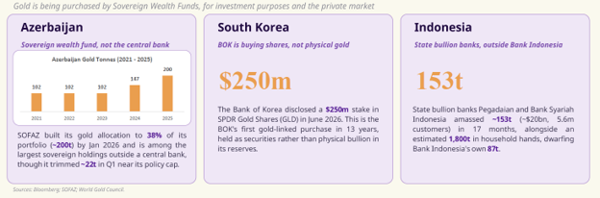
It's not just central banks that are buying. By January 2026, the State Oil Fund of the Republic of Azerbaijan (SOFAZ) held around 200 tonnes of gold, 38% of its portfolio, though it sold about 22 tonnes in the first quarter as it neared its own limit on gold holdings. The Bank of Korea disclosed a $250 million stake in a gold ETF in June, its first gold-linked purchase in 13 years. Indonesia's state bullion banks, Pegadaian and Bank Syariah Indonesia, gathered about 153 tonnes in 17 months, alongside an estimated 1,800 tonnes held by households, far more than Bank Indonesia's own 87 tonnes.
Individuals are buying too. Global bar and coin demand hit 784 tonnes in the first half of the year, one of the strongest on record.
Why they might be buying
Reserve diversification: 74% of reserve managers surveyed expect the dollar's share of reserves to fall within five years. Central banks bought about 1,000 tonnes a year in 2022-2025, double the previous decade's average.
Investment allocation: Wealth funds and other investors hold gold as part of their portfolios, positioning for higher prices.
Price: Some of China's import surge was linked to lower gold prices and a stronger yuan, so part of the buying is opportunistic.
The tug-of-war
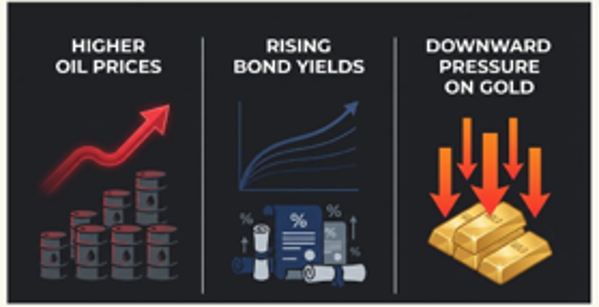
What's pulling gold down: Higher oil prices, linked to US-Iran tensions around the Strait of Hormuz, are keeping inflation worries alive and interest rates high. The US Federal Reserve (the Fed) raised rates in September, and the two-year Treasury yield rose from about 4.1% to 4.9% in five weeks, making gold, which pays no interest, less attractive.
What's pulling it up: Gold has dipped to around $4,000 several times, hitting $3,959 on 24 June and $3,994 on 29 July, but has bounced back each time. Long-term buying has stepped in on each dip, including steady purchases by China's central bank. The US Treasury has also doubled its long-bond buybacks to $4 billion per operation, aimed at capping yields, which would likely weaken the dollar over time and support gold.
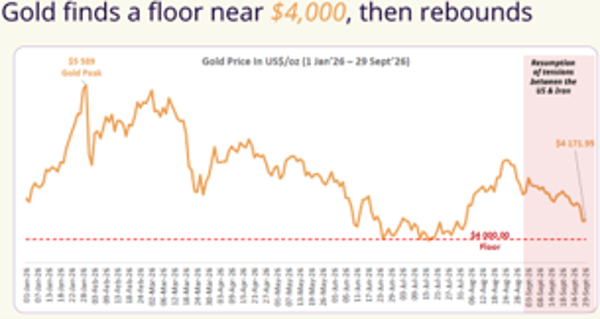
Long-term buyers and investors have used the decline in gold prices to increase their holdings. China's central bank did the same, accelerating its gold purchases in September as prices fell, with a purchase of 23 tonnes in September.
What to watch
Warsh's Fed review: Kevin Warsh, who became Fed Chair in May, has set up five task forces to rethink how the Fed operates, including how it judges inflation. They are due to report at the end of 2026. If their conclusions point to lower inflation, that could clear the way for rate cuts, which would help gold, with 2027 the earliest. Warsh hasn't said which way rates will go.
Inflation data: The Fed is currently on hold and will react to the inflation data. If the conflict remains unresolved and oil prices remain high, that will put pressure on gold prices. If there is a peace deal and Hormuz is open, oil prices will go down and so will inflation, and that will be very positive for gold and will allow it to rise significantly.
China's pace: China's central bank may slow its buying if gold approaches its all-time highs.
US-Iran conflict: If the conflict eases, oil prices and inflation should fall, giving gold more room to rise.
Buyers have stepped in each time gold has tested $4,000, but oil, interest rates and Fed policy could still sway it in the near term. Whether that level holds is the question to watch.